

Tarot Guide Addendum & Errata

While it may seem like I haven’t been writing over here I have put in some significant edits to the Guide to the Oldest Tarot Cards! These updates were based on feedback that I have received from members of the Tarot History group on Facebook. I have also been working on a .pdf optimized version of the guide for the group..
An Omnibus Edition will be available for download over on the Into Mystery Telegram shortly after this posts goes out!
The omnibus edition brings together the entire guide in one convenient document for 97 total pages!
Here is a summary of the major changes that have been made, please consult the original post for an unabridged version.
Vol. I:
Rothschild - Bassano
This pack only contains the 7 court cards and Emperor from the Louvre and the Cavallo from the Bassano del Grappa.
Rothschild - Correr
The 23 pip cards in the Rothschild collection at the Louvre are more properly thought to belong with the cards at the Museo Correr in Venice. This was a bit confusing as Dummett stated in The Game of Tarot that they cannot actually be from the same pack, since the dimensions do not tally (180 X 93 mrn. for the Correr cards, 188 x 90 mm. - or, according to Hoffmann, 186 x 93 mm. - for the Rothschild ones). [Pg. 72] but then later in Il Mondo he wrote have the same dimensions [Pg. 85]. Unfortunately the Correr Museum does not show their cards so I do not have an updated measurement though I suspect they are the same as what the Louvre lists for their counterparts. What’s more is Rothschild-Correr was Dummett’s group 26 in Il Mondo so I really should have caught this since I discussed group 27.
Thank you to Marco Cesare Benedetti for pointing this out!
Vol. III:
Budapest Sheets
This entry in particular received the most substantial update. I decided to shorten the name as the sheets in the Budapest Museum of Fine Arts are more complete and their collection of fragments is the most substantial. Based on feedback that I received from Nathanial Shockley I decided to check out two articles that he wrote for The Playing Card1 about the family of fragments which includes the Budapest sheets. These fragments were dubbed by Dummett as archaic and have been a long standing mystery in playing card research. In his two articles Shockley presented an in depth study of these fragments firmly establishing their Venetian origins as well as deducing date range for when each series was created. These articles required a paid membership to the International Playing Card Society to read but after writing about playing cards all year I figured I may as well. So far it’s been worth it! From Shockley’s article alone I found out about the Tarot Bolonais (below), a pair of ancient cards previously unknown to me. I also learned about extra sheets that were found in the Rosenwald family previously unknown to me. Presumably the 2 non-tarot Rosenwald sheets were their own standalone deck of 48 cards, 10s and Queens removed. This might be the earliest hard proof of a shortened pack.
I am sure more stuff will come to light as I delve deeper into back issues of The Playing Card but any more insights will have to wait for a 3rd edition of this Guide. For now, the Budapest entry has been updated to reflect a Venetian origin and a creation date of ~1530-1540. Rosenwald has been updated as well.
Vol. IV:
Tarot Lyonais
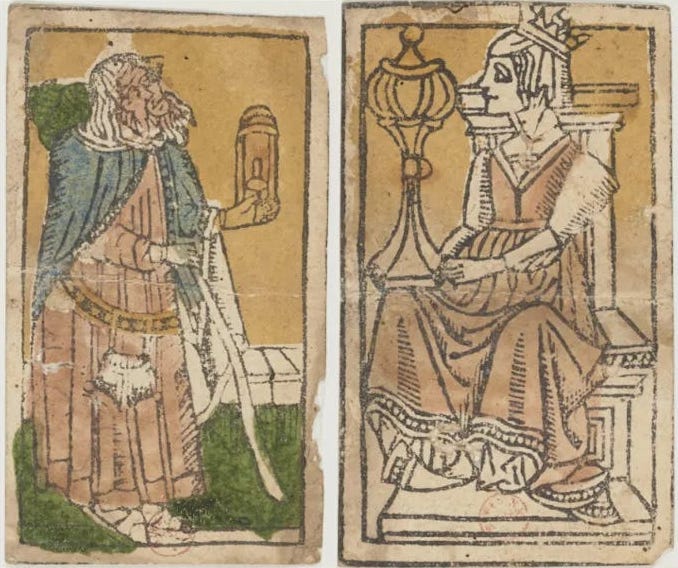
2 cards previously unknown to me in the BNF: a Hermit and a Queen of Cups. These had been discovered in 1985 but didn’t receive an attribution for decades later. In a 2016 article in The Playing Card, Thierry Depaulis wrote that he thought they might be French, manufactured in Lyon towards the end of the fifteenth century. As of writing I am unaware of any further study into these cards though this attribution hardly seems like a final answer. As it stands, taking the earlier estimate of 1485, it would seem that these are the oldest mass produced woodcut playing cards. From these cards one could also infer that the origin of the Hermit’s lantern was the result of a French re-imagining of the card.
Vol. V:
Lombardy I & III
This group has been updated with the pictures from Kaplan’s Encyclopedia Vol. II which I do not own, special thanks to Ross Caldwell for getting those out to me! I decided to just leave these two together as one group. I don’t really think pack count matters at this point as many of these fakes/forgeries were likely intended to be sold as singles and were never part of a complete pack to begin with.
That’s about it for the updates, I will be releasing a similar guide on the various versions of the Tarot de Marseille later this month so be sure to subscribe! Also check out the Telegram for the free PDF e-book, that is only going to be available there for a limited time.
Nathaniel Shockley, Playing Cards in Renaissance Venice - Part I: Place, The Playing Card,
Vol. 52, No. 3 (Jan - Mar 2024) & Playing Cards in Renaissance Venice - Part II: Time, The Playing Card, Vol. 53, No. 1 (Jan-Mar 2025)